
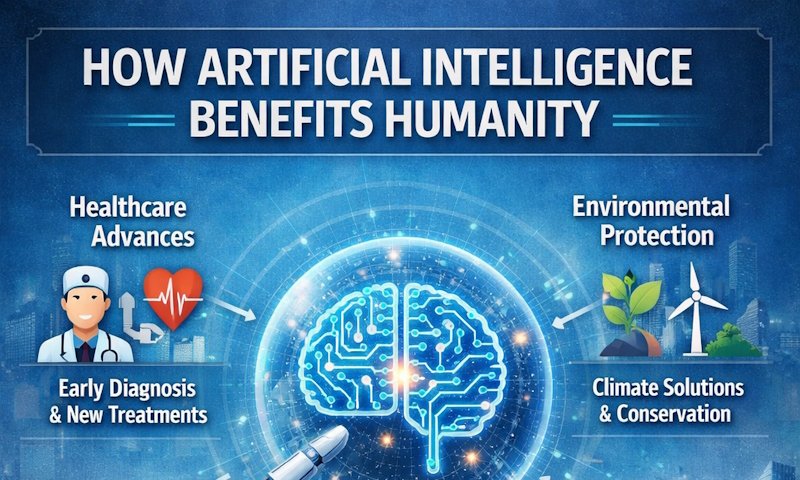
Artificial Intelligence (AI) is one of the most transformative technologies in human history. Once a concept of science fiction, AI is now deeply embedded in everyday life—powering smartphones, improving healthcare, optimizing businesses, and helping solve global challenges. When developed and used responsibly, AI has the potential to greatly enhance human well-being, productivity, and quality of life.
1. Improving Healthcare and Saving Lives
One of AI’s greatest contributions is in healthcare. AI-powered systems can analyze medical data faster and more accurately than humans in many cases. They help doctors detect diseases such as cancer, heart conditions, and neurological disorders at earlier stages, increasing survival rates.
AI also assists in drug discovery, reducing the time and cost required to develop new medicines. Robotic surgery, AI-driven diagnostics, and personalized treatment plans are making healthcare more precise and accessible. In remote or underserved areas, AI-powered telemedicine allows patients to receive care where doctors are scarce.
2. Enhancing Education and Learning
AI is transforming education by making learning more personalized and accessible. Intelligent tutoring systems adapt to a student’s learning pace, strengths, and weaknesses. This helps students understand difficult subjects more effectively than one-size-fits-all teaching methods.
AI also supports teachers by automating grading, organizing lesson plans, and identifying students who may need extra help. Language translation tools and speech recognition have removed barriers for learners worldwide, opening access to education regardless of location or language.
3. Increasing Productivity and Economic Growth
AI improves efficiency across industries by automating repetitive tasks and optimizing workflows. In manufacturing, AI-driven robots increase production speed and precision. In offices, AI tools handle scheduling, data analysis, customer support, and document processing.
This automation allows humans to focus on creative, strategic, and interpersonal work. Businesses benefit from reduced costs, better decision-making, and faster innovation—contributing to economic growth and new job opportunities in AI-related fields.
4. Making Daily Life Easier and Smarter
AI has become a helpful companion in everyday life. Virtual assistants manage calendars, answer questions, and control smart homes. Recommendation systems help users discover music, movies, products, and news that match their interests.
Smart home technology uses AI to improve energy efficiency, enhance security, and increase comfort. From traffic navigation apps to voice-controlled devices, AI saves time and simplifies routine tasks.
5. Supporting Environmental Protection
AI plays a growing role in protecting the planet. It helps monitor climate change, predict natural disasters, and optimize energy usage. AI-powered systems can analyze satellite data to track deforestation, pollution, and wildlife populations.
In agriculture, AI enables precision farming—reducing water waste, minimizing chemical use, and improving crop yields. These innovations help promote sustainability while meeting the food needs of a growing global population.
6. Advancing Science and Research
Scientific progress has accelerated thanks to AI’s ability to process vast amounts of data. AI helps researchers discover patterns, simulate experiments, and solve complex problems in physics, chemistry, and biology.
From mapping proteins to exploring space, AI is expanding human knowledge at an unprecedented pace. Discoveries that once took years can now happen in months or even days.
7. Enhancing Safety and Security
AI contributes to public safety by improving fraud detection, cybersecurity, and emergency response systems. It can identify suspicious activity, prevent financial crimes, and assist law enforcement in analyzing evidence.
In transportation, AI powers advanced driver-assistance systems and autonomous vehicles, which aim to reduce accidents caused by human error and make roads safer.
8. Empowering Creativity and Innovation
AI is not just analytical—it is creative. It helps artists, writers, musicians, and designers generate ideas, compose music, edit videos, and design graphics. Rather than replacing creativity, AI acts as a tool that enhances human imagination and productivity.
Creators can experiment faster, explore new styles, and bring ideas to life with fewer technical barriers.
Conclusion
Artificial Intelligence is a powerful force for good when guided by ethical principles and responsible development. It enhances healthcare, education, productivity, sustainability, and creativity while solving problems once thought impossible.
As AI continues to evolve, its greatest value lies not in replacing humans but in empowering them—helping humanity live healthier, smarter, and more connected lives. When used wisely, AI has the potential to be one of humanity’s greatest allies in shaping a better future.