
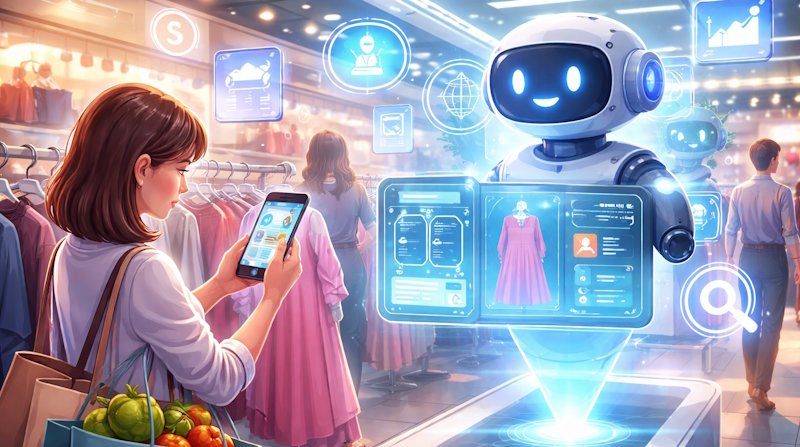
Artificial intelligence isn’t just a back-office analytics tool anymore — it’s becoming a front-line force shaping how consumers discover, explore, choose, and buy products online and in physical stores. From major tech platforms introducing agentic checkout features to retailers using AI to personalize every step of the journey, the era of “smart shopping” is here. Shopify+1
🌟 1. Conversational & Agentic AI — Shopping With Your Personal Assistant
One of the biggest recent advancements is agentic AI — autonomous digital assistants that act on your behalf. Instead of simply answering questions, these systems can find products, compare prices, and even complete purchases. blog.google
- Google Shopping’s AI Mode now lets users describe what they want in everyday language and returns an organized set of options complete with prices, reviews, and inventory — reducing endless scrolling and tab hopping. blog.google
- Retail giants like Amazon are integrating generative and agentic AI into recommendations and workflows designed to streamline discovery and checkout. About Amazon
Experts also describe a broader concept called agentic commerce — where AI agents manage shopping tasks for both consumers and merchants, personalizing experiences and automating decisions. McKinsey & Company
🛍️ 2. Personalization at Scale — Tailored Just for You
AI excels at analyzing vast amounts of data — from browsing history to purchase patterns — to predict what you’ll want next. This isn’t about generic product lists anymore; it’s about hyper-personalized recommendations that feel curated by a stylist or trusted advisor. Coderapper
- Retailers can suggest products based on real-time behavior and past purchases, increasing conversion rates and customer satisfaction. Coderapper
- Loyalty programs and AI-driven offers are increasingly tailored to individual shopping habits, making promotions more relevant and increasing repeat purchases. Coderapper
📸 3. Visual Search & Augmented Reality (AR) Try-Ons
Visual shopping leverages AI to change how products are found and evaluated.
- Visual search: Instead of typing keywords, shoppers can upload or scan images to find similar products across platforms. jotform.com
- AR try-ons: Virtual fitting rooms let consumers see how clothes, eyewear, makeup, or furniture look before purchasing — a game-changer in reducing returns and boosting confidence. Glance
- Innovative companies in fashion tech, like DRESSX, have even launched AI black-box tools that combine virtual try-ons with direct shopping from thousands of brands. Wikipedia
🛒 4. AI-Powered Store Experiences & Smart Commerce
AI isn’t confined to screens — it’s reshaping physical retail too:
- Cashierless shopping: Smart sensors and machine learning let shoppers grab items and leave while the system automatically charges their accounts. Uniqode
- Inventory and logistics AI: Predictive models help stores keep optimal stock, avoid running out of popular products, and streamline supply chains. BiztechCS
- Some startups are even testing autonomous “store-in-a-box” concepts, self-contained shops powered by AI and robotics that operate without staff. Reddit
🗣️ 5. Smarter Chatbots & Voice Shopping
AI chatbots are no longer scripted FAQ machines — they’re conversational, context-aware assistants capable of:
- guiding shoppers to products,
- answering complex questions,
- helping with returns and order tracking,
- and even closing purchases within the chat interface. Glance
Voice commerce — enabled by assistants like Amazon Alexa, Google Assistant, or integrated LLMs — also continues to grow, letting consumers search and buy using natural speech. feedonomics.com
💡 6. Dynamic Pricing and Market Strategy
AI can evaluate competitor pricing, demand, and inventory levels in real time, enabling dynamic pricing that adjusts offers to maximize conversion and profitability. Glance
However, this capability has also sparked controversy: recent AI-driven pricing experiments (e.g., on grocery platforms) were halted after public backlash about price fairness, highlighting a need for ethical pricing practices. The Verge
Challenges & Ethical Considerations
As AI becomes deeply embedded in shopping:
- Consumer privacy and data use are key concerns: customers want transparency about how their info is used.
- Fairness in pricing and personalization must be balanced with ethical standards to avoid discrimination or exploitation.
- Retailers must ensure AI recommendations are accurate, unbiased, and respect consumer rights.
What’s Next?
The future of AI in shopping points toward fully autonomous commerce, where agents anticipate and handle many tasks shoppers currently perform manually. AI will also continue to blend physical and digital experiences, making shopping faster, more contextual, and more enjoyable than ever.
As both retailers and technology platforms invest heavily in these systems, 2026 promises deeper integration of AI across every step of the shopping journey — from discovery to delivery.